
Translate a product label in place into 4 languages with Ideogram 4.5
Swap approved label copy per market with one Ideogram 4.5 edit each on Sume: a copy-deck prompt, $0.15 for four languages at low, and a proofing list.
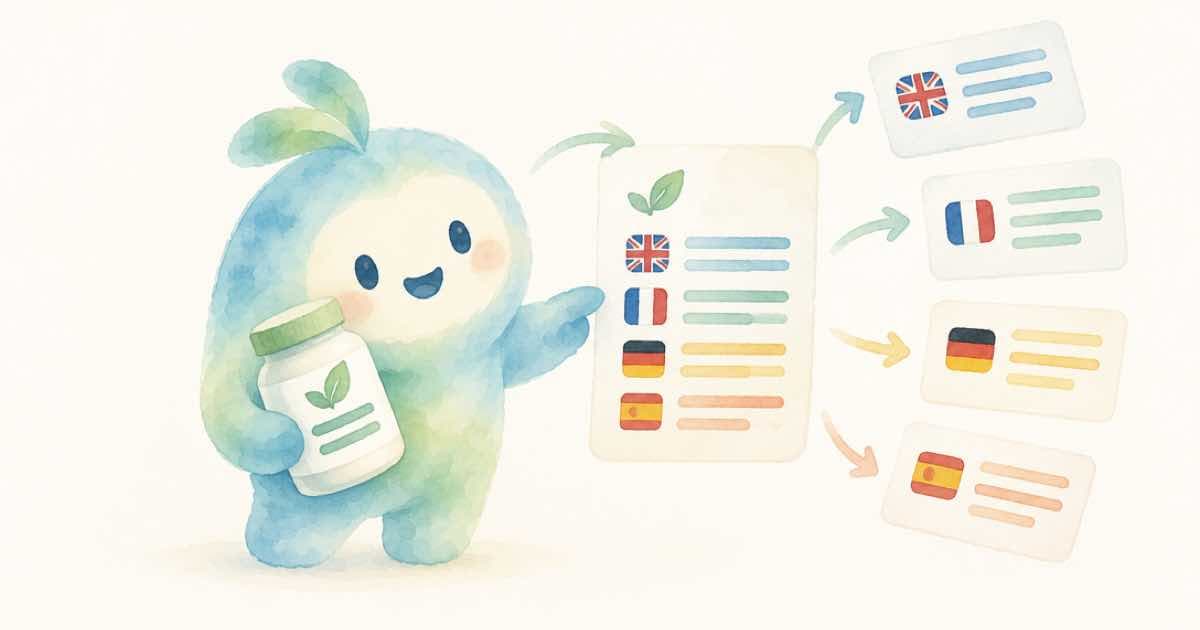
To translate a product label in place, give Ideogram 4.5 the finished label image as the first input_references entry on POST /v1/images and put the exact approved text for each line in the prompt, so the model places your words and does not invent its own. Four languages are four edits: $0.15 at low quality and $0.30 at medium on Sume, which bills Ideogram's $0.03 and $0.06 list prices times 1.25.
The rule that keeps this safe: the model draws the words, you write them. Ingredient lists, allergen statements, net-content lines and claims are regulated copy. Have a qualified person produce and approve each translation in a copy deck, then use the edit only to put those approved strings on the artwork. Nothing the model translates on its own belongs on a pack.
What does a copy-deck prompt look like?
Keep one table of lines per market and generate the prompt from it. Each line pairs the old string with the new one, so nothing is left to guess. Ideogram describes 4.5 as an edit model that keeps its changes local (Ideogram on X, read 2026-10-05); you should still write the prompt as if it did not, and say what to leave alone.
{
  "model": "ideogram/ideogram-v4.5",
  "quality": "medium",
  "prompt": "Edit the label. Replace exactly these texts, keep font, size, color and position of each: 'Cold Brew' -> 'Café helado'; 'Less sugar' -> 'Menos azúcar'; 'Shake well' -> 'Agitar antes de usar'. Do not change the logo, the bottle, the background or any other text.",
  "input_references": [
    {"type": "image_url", "image_url": {"url": "https://example.com/label-en.png"}}
  ]
}
How much does a label set cost?
The price is per image and does not depend on size, so a label at 1K and a label at 2K cost the same.
| Languages | At low ($0.0375) | At medium ($0.075) | At high ($0.275) |
|---|---|---|---|
| 1 | $0.0375 | $0.075 | $0.275 |
| 4 | $0.15 | $0.30 | $1.10 |
| 10 | $0.375 | $0.75 | $2.75 |
| 25 | $0.9375 | $1.875 | $6.875 |
Why edit a flat label and not the whole bottle?
A curved bottle changes how letters wrap, and an edit has to redraw those curves. When you have the flat label artwork, edit that file and apply it to your bottle render afterward, as in the bottle label mockup recipe. When you only have a photo of the finished pack, edit the photo, then read the curved text with extra care.
A launch-partner page (Morphic, a partner and not the vendor, read 2026-10-05) says the model translates stylized text in place and copies unchanged pixels from the source. Sume's docs make no such promise, so the proofing step below is not optional.
A proofing checklist for label edits
Run this on every output before it goes to a printer or a store page:
- Read every changed string against the copy deck, letter by letter, including accents and punctuation.
- Compare every unchanged region with the source: logo, barcode, certification marks and the net-content line. A moved or redrawn barcode is a reject.
- Check text fit. A longer translation may shrink or wrap; fix the translation length, not the model.
- Save as PNG between passes, per the image-edit chain recipe. Re-compressing JPEG adds artifacts that look like model drift.
Jobs, retries and status codes
The route waits up to 30 seconds and returns 200 with data[0].url. If a high run takes longer, it returns 202; branch on the status code and poll status_url, as described in Jobs and results. Send Idempotency-Key: label-es-v1 so a retry does not bill a second edit.
How do I keep the copy deck and the image in step?
Treat the copy deck as the source of truth and the image as an output. Keep one row per language with the exact string for each label field, generate the prompt from that row, and store the prompt with the job id. When legal changes a line, you edit one cell and re-run one language, not four.
Re-run only the language that changed, with a new Idempotency-Key, since a reused key with a changed prompt is not a new request. At low quality a single re-run costs $0.0375 on Sume, so correcting one language is cheaper than debating it.
Sources
Related posts
More in Use cases
- Translate chart and diagram labels in an image with Ideogram 4.5
Swap the axis titles, legend and callouts of a chart image into another language with one Ideogram 4.5 edit per language: $0.0375 each at low on Sume.
- Translate your comic's speech bubbles: one Ideogram 4.5 edit per page
Letter a 20-page comic in 3 languages with Ideogram 4.5 edits on Sume: one call per page, 60 calls, $2.25 at low quality, and why per-bubble calls cost 6x.
- Translate small print on a pack: edit the panel crop, paste it back
For ingredient-panel small print, crop the panel, send only the crop to an Ideogram 4.5 edit at high quality, and paste it back with Pillow. Proof every word.
- Translate a restaurant menu image into Spanish and French on Sume
Translate the text in a menu image with Ideogram 4.5: one edit call per language from the original, with prices and dish names kept. Python loop included.
Written by Sume