
Cyber Monday 2026 hook test: 12 hooks at 5, 10, 15 s cost
Testing 12 hooks at three lengths on Wan 3.0 is 360 seconds of video: $22.50 at 480p, $45 at 720p, $90 at 1080p. The grid, the maths and when to stop.
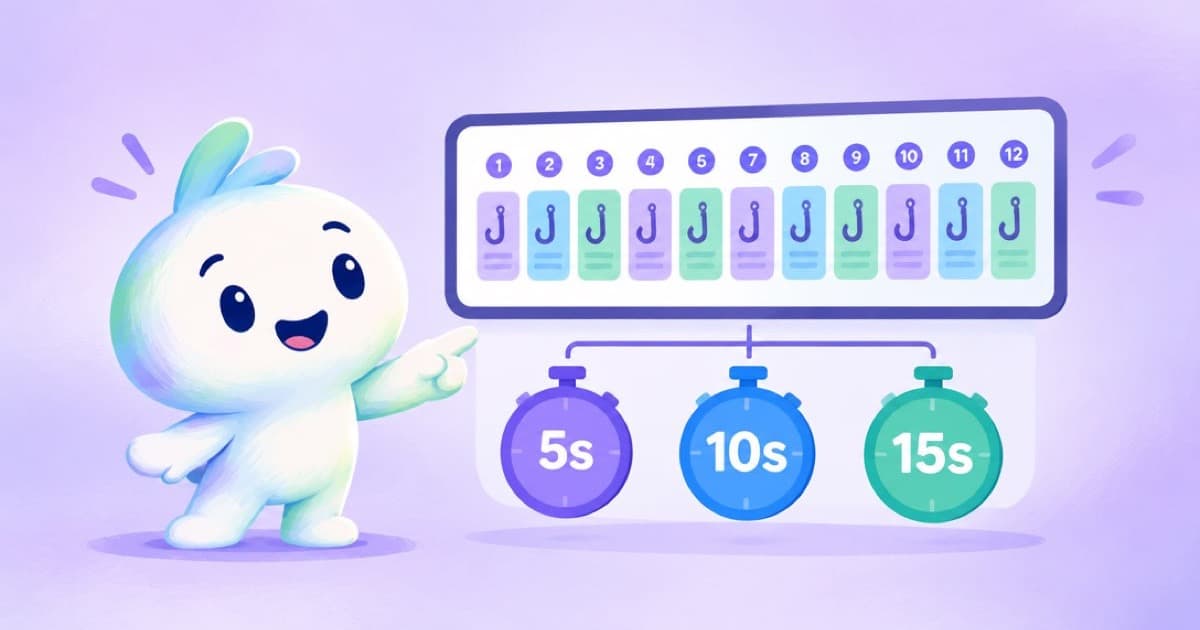
Cyber Monday 2026 is November 30, a Monday, 58 days after October 3. A common test shape for a promotion is a grid: several hooks, each cut at several lengths, so you can see which opening and which running time hold attention. On Sume the cost of that grid is pure arithmetic, because Wan 3.0 is billed per second by resolution and nothing else.
Twelve hooks at 5, 10 and 15 seconds is 12 x 30 = 360 seconds of video. Multiply by the per-second rate for the resolution you choose.
What does the grid cost at each resolution?
Wan 3.0 accepts 2 to 30 seconds at 480p, 720p and 1080p. Sume's billed rates are $0.0625, $0.125 and $0.25 per second, which are the provider list rates times 1.25.
Read the last column as the whole grid. The 480p grid is exactly a quarter of the 1080p grid: $22.50 against $90.
| Resolution | Rate per second | Seconds per hook | One hook, three lengths | 12 hooks |
|---|---|---|---|---|
| 480p | $0.0625 | 5 + 10 + 15 s = 30 s per hook | $1.875 | $22.50 |
| 720p | $0.125 | 5 + 10 + 15 s = 30 s per hook | $3.75 | $45.00 |
| 1080p | $0.25 | 5 + 10 + 15 s = 30 s per hook | $7.50 | $90.00 |
Does it make sense to test at 1080p?
Usually not. Resolution does not change a hook's idea, so screen at 480p, keep the winners and re-render only those at the delivery resolution. If three of twelve hooks survive, re-rendering them at 15 seconds and 1080p is 3 x 15 x $0.25 = $11.25. The full plan is $22.50 plus $11.25 = $33.75, against $90 for rendering the whole grid at 1080p first.
A seed is not guaranteed to reproduce a clip across resolutions on every model, so treat the 1080p re-render as a new generation, not a sharper copy of the screen. The 480p draft then 1080p final post explains what changes.
What do you do with the results?
Run the grid as a bulk run or as three runs of four. Concurrency on Pro is 4 jobs at once with a queue of 20, so 36 jobs (12 hooks x 3 lengths) hold 24 accepted at a time; stage them in two submissions to avoid 429 queue_full. Startup accepts 48, so the whole grid fits in one submit.
Each job reserves its own price on submit and captures it on success, so a full grid on a funded wallet cannot exceed the table total. Pick the length that wins for each hook, then spend the remainder on captions, which are $0.20 per job.
Sources
Related posts
More in Use cases
- Cyber Week is $47.5B, 17.3% of the season: a 7-day clip schedule
Adobe puts Cyber Week at $47.5B and 17.3% of holiday sales. A seven-day plan for product clips and offer variants that you can produce ahead of Thanksgiving.
- Day-in-my-life Reel from 12 clips: one Timeline render and its cost
Cut 12 phone clips into a 48-second day-in-my-life Reel: slot timings, a silent spine with a music bed, and what the render costs at Sume's listed rates.
- Day of the Dead ofrenda video from family photos, for Nov 1 and 2
Make a 40-second Day of the Dead tribute from eight family photos, two marigold stills and a music bed: static holds, no face animation, about $0.48 on Sume.
- Demand Gen A/B experiment: 50 conversions per arm, then what?
Google asks for at least 50 conversions per arm in Demand Gen conversion experiments. What that means for how many AI video variants you can afford to test.
Written by Sume