
Speechify API Starter, Pro, Scale: monthly bill vs Sume TTS
Speechify's API plans cost $10, $99 and $499 a month with included characters. See the bill at 1.9M to 100M characters next to Sume's flat $47.50 per million.
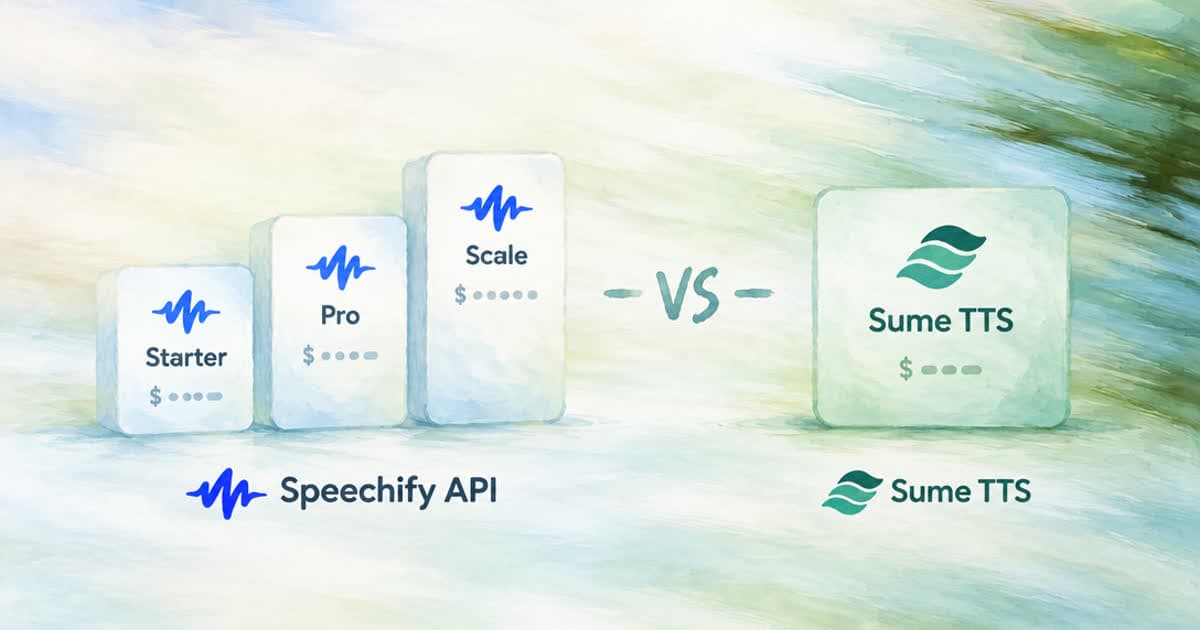
For text to speech alone, Speechify's API is cheaper per character than Sume at every volume on its price page. Its Scale plan costs $499 a month for 78M characters; the same 78M characters on Sume's TTS rate of $0.0475 per 1,000 characters cost $3,705. Sume is the better fit only when speech is one step in a job that also makes video or images and you want one prepaid balance.
This post prices a month of characters on each plan, using only the numbers printed on Speechify's pricing page and Sume's API rate card.
What do Speechify's three paid API plans include?
Speechify lists a Free plan with 500K characters a month, then three monthly plans with no annual commitment. Each plan adds its included characters to one dollar balance, and usage past that balance is drawn at the plan's overage rate from a top-up.
| Plan | Monthly fee | Included characters | Rate after included |
|---|---|---|---|
| Starter | $10 | 1.9M | $10 per 1M |
| Pro | $99 | 13.5M | $8 per 1M |
| Scale | $499 | 78M | $6 per 1M |
What does Sume charge for the same characters?
Sume's TTS is priced per 1,000 characters at $0.0475, which is 3.14 credits, and spaces and punctuation count. The catalog sets a minimum of 1 cent and a maximum of 20,000 characters per request. That is $47.50 per million with no plan fee and no volume tier in the catalog, so the cost is arithmetic you can do from the character count.
Both text-to-speech routes, the single-voice model and the router, carry the same rate in the catalog. Call details are in the API reference.
What is the monthly bill at 1.9M to 100M characters?
The table picks the cheapest Speechify plan that makes sense at each volume and assumes you pay overage at that plan's rate. Sume's column is volume times $47.50 per million.
| Characters | Speechify plan | Speechify bill | Sume bill | Sume vs Speechify |
|---|---|---|---|---|
| 1.9M | Starter | $10.00 | $90.25 | 9.0x |
| 5M | Starter | $41.00 | $237.50 | 5.8x |
| 13.5M | Pro | $99.00 | $641.25 | 6.5x |
| 20M | Pro | $151.00 | $950.00 | 6.3x |
| 78M | Scale | $499.00 | $3,705.00 | 7.4x |
| 100M | Scale | $631.00 | $4,750.00 | 7.5x |
Where does the gap come from, and when does it matter?
The gap is large because Speechify sells speech as the product and Sume bills TTS at a rate that sits next to video, image and music rows on one rate card. At 1.9M characters, Sume is about nine times the Starter bill; at 100M it is about seven times the Scale bill.
It matters when speech is the whole workload, such as a reading app or a voice-over batch with nothing else attached. It matters less when a few thousand characters of narration feed a clip, because 5,000 characters of narration cost about 24 cents on Sume.
Which should you pick?
If you only need speech and expect more than about 2M characters a month, pick the Speechify plan from the first table. Check its language list first: the page says self-serve covers English on Simba 3.2 and six languages on Simba 3.0, with wider coverage through sales.
If speech sits inside a video or image pipeline and the volume is small, one Sume balance and one set of keys avoids a second vendor. Compare the real totals before choosing, and see the broader cheapest TTS API list for other vendors.
Sources
Related posts
More in Pricing
- What list x 1.25 adds per second on Sume video, by model
Sume's 1.25 margin adds $0.0125 to $0.2843 per second on the rows in this table. Table of list, margin and total, read 2026-10-13.
- TTS price per 1,000 characters: every Sume row next to MAI-Voice
Sume's TTS Router bills $0.0475 per 1,000 characters on Sonic rows and $0.05 to $0.125 on Eleven rows; Microsoft lists MAI-Voice-2.1 at $0.022.
- Vidu Q4 Preview $0.014 is a launch rate: how to budget on it
Vidu says Q4 Preview's $0.014 per second is launch pricing and may vary by plan and region. Budget with a margin; Sume prices at list x 1.25.
- How Sume pricing works: plans, one wallet, published model rates
Sume plans set access and concurrency. Usage draws from one prepaid wallet at each model's published USD rate, for generation, the Agent, Formats, and the API.
Written by Sume