
Clip reject rate: what 25% and 50% rejects add to 40 kept clips
40 kept 8-second clips cost $40.00 on Wan 3.0 at 720p with no rejects, $53.33 at 25% rejected and $80.00 at 50%. Four models priced in one table.
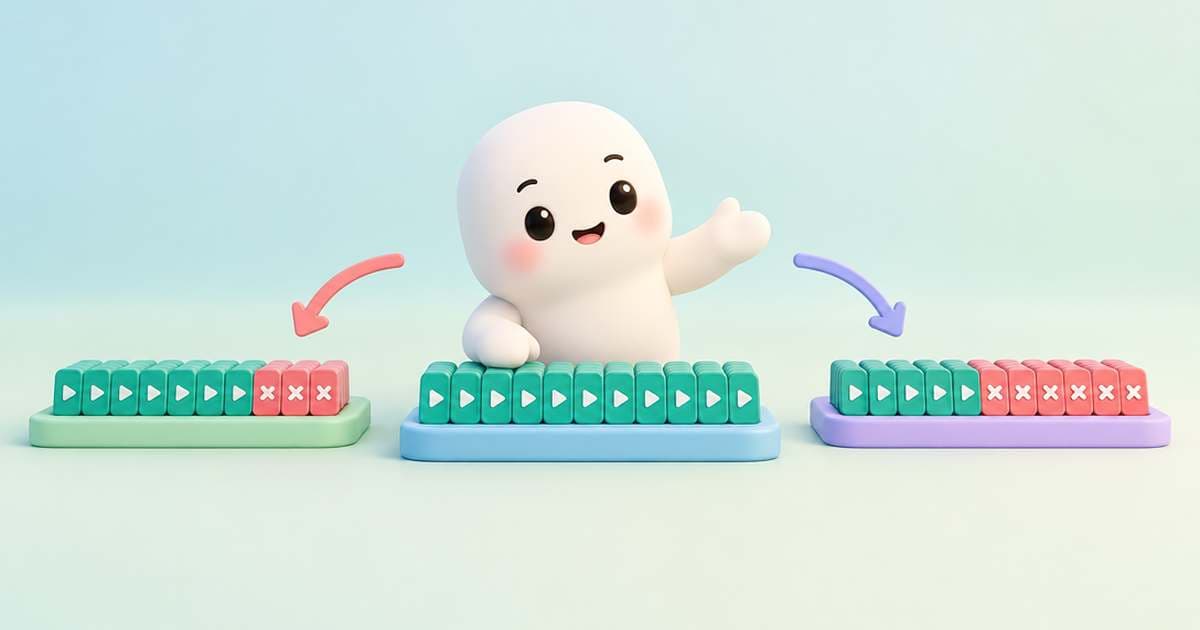
If one take in four is rejected, 40 kept 8-second clips cost one third more than the no-reject price: $53.33 instead of $40.00 on Wan 3.0 at 720p. At a 50 percent reject rate the bill doubles to $80.00.
Sume billable amounts, read 2026-10-03. The formula is kept clips times seconds times rate, divided by the share of takes you keep.
The table
The same 40 kept clips cost very different amounts by model, and the reject rate multiplies whichever base you start from.
| Model | No rejects | 25% rejected | 50% rejected |
|---|---|---|---|
| Wan 3.0 | $40.00 | $53.33 | $80.00 |
| Gemini Omni Flash 1.1 | $40.00 | $53.33 | $80.00 |
| Seedance 2.0 Mini | $60.48 | $80.64 | $120.96 |
| Seedance 2.5 | $184.90 | $246.53 | $369.79 |
Why the multiplier is not linear
A 25 percent reject rate means you generate 4 takes to keep 3, a multiplier of 1.33. A 50 percent rate generates 2 takes per keeper, a multiplier of 2. A 75 percent rate generates 4 takes per keeper, a multiplier of 4. Reject rates compound on the expensive models, since 4 times Seedance 2.5's base is $739.58.
Method and assumptions
Every clip is 8 seconds at 720p. A clip's price is its seconds times the per-second rate, and a rejected take is billed the same as a kept one because generation already happened. The table makes no claim about what reject rate you will see; measure it on a pilot batch of ten before budgeting forty.
Cheap drafts help here. A pilot on a low-priced model at 480p tells you whether a prompt works before you spend the 720p price on it.
What Sume does and does not do
Sume reserves each clip's price at submit and bills it per output second at the model and resolution you pick. It does not judge which takes are keepers, so the reject rate is yours to measure. Confirm current rates in the catalog.
Rerun the arithmetic
The same line items as a short script, so you can change a quantity and see the total. It is plain arithmetic on the rates in this post; it does not call the Sume API.
# Sume billable USD rates, read 2026-10-03. Edit the quantities.
lines = [
    ('Wan 3.0 720p seconds, 40 kept x 8 s', 320, 0.125),
]
total = 0.0
for label, qty, unit in lines:
    cost = qty * unit
    total += cost
    print(f"{label:<46}{qty:>8g} x {unit:<10g} = ${cost:,.2f}")
print(f"{'Total':<46}{'':>8}   {'':<10}   ${total:,.2f}")
Sources
Related posts
More in Pricing
- Retell AI pricing per minute: $0.07 to $0.31, line by line
Retell lists $0.055 for voice infrastructure, $0.015 for most TTS, an LLM line and $0.015 telephony. Add them up, and see how Sume's TTS price compares.
- Runway credit price by plan: $0.024 on Standard to $0.008 on Max
A Runway credit costs $0.024 on Standard monthly, $0.0192 annual and $0.008 on Max annual, against $0.01 through the API. Gen-4.5 per second follows.
- Season budget ceiling: spend cap per episode times the queue size
Cap each Sume bulk item with generation_spend_cap_usd and the queue has a hard ceiling: cap times items, with concurrency limiting what is exposed at once.
- Season polling budget by plan: reads per minute for Free to Scale
Sume rate limits are per key and per plan, reads at 40 times writes. Size a season poller against Free 4,800 to Scale 48,000 reads a minute.
Written by Sume