
Plan a 20-ad test: four hooks times five visuals
Twenty ads from one product is four hooks times five visuals. How to lay out the grid so you learn which half won, and how to name the files.
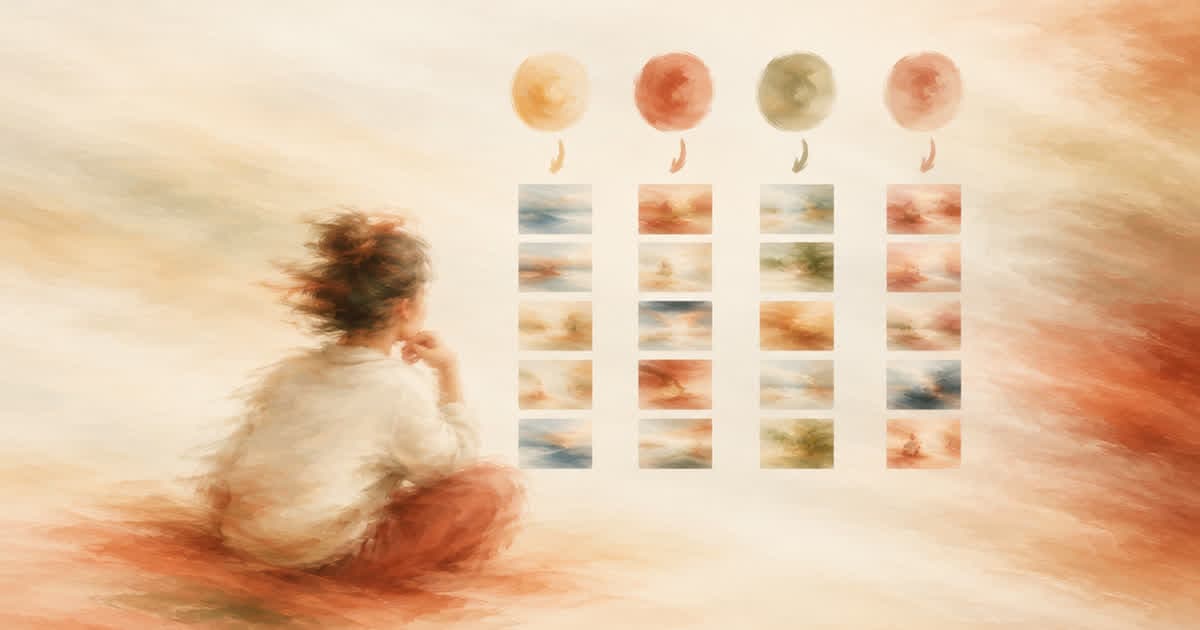
A 20-ad test from one product is a grid of 4 hooks by 5 visuals, so each hook appears in 5 ads and each visual in 4, and you can read which hook and which visual did better. Higgsfield's changelog, read 2026-10-02, says Ads Studio produces up to 20 ads per product; the count is only useful if the 20 are planned.
Image requests in the grid use Sume's Image API fields; planning advice is general.
How do I build the grid?
Pick 4 headlines and 5 visual treatments, such as a plain background, a lifestyle scene, a close-up, a gift setting, and a flat lay. Each cell is one ad. Keep the logo, ratio, and product photo the same in all 20.
| Hook | Plain | Lifestyle | Close-up | Gift | Flat lay |
|---|---|---|---|---|---|
| Hook A | A-1 | A-2 | A-3 | A-4 | A-5 |
| Hook B | B-1 | B-2 | B-3 | B-4 | B-5 |
| Hook C | C-1 | C-2 | C-3 | C-4 | C-5 |
| Hook D | D-1 | D-2 | D-3 | D-4 | D-5 |
How do I generate it on Sume?
One request per hook, with n: 4 or the model's own ceiling, only gives the same prompt several times. For a visual grid, send one prompt per cell, or one prompt per hook and let n supply variety. 20 ad variations from one product image shows the first pattern.
How should I name files?
Name each by cell, such as A-3.png, and record the prompt next to it. When results come back, you can sort by hook or by visual and see which row or column carries the signal.
What would I not read into a result?
Small differences on a small spend are noise. Run the winner against a fresh set before you scale; ad variations for video ads covers the same discipline for video.
Decide before you generate what a win is, such as a click rate or a saved share, and how many impressions each cell needs. Without that, a grid of 20 produces 20 opinions. Keep the grid sheet next to the results so that, later, you can say which hook and which visual carried the lift.
Sources
Related posts
More in Use cases
- Podcast audiogram API: audio plus a cover still in one render
Make a podcast audiogram video from an audio clip and a cover image with Timeline 1.0: spine, still slot, square output and the cost per minute.
- Podcast loudness: Apple -16 LKFS, Spotify -14 LUFS, and Sume
Apple recommends about -16 LKFS with -1 dB true peak. Spotify's normal level is -14 LUFS. Sume has no loudness normalizer: what it offers instead.
- Poshmark listing photos are 3:4 portrait: how to make them
Since March 2026 Poshmark listing and cover photos are portrait 3:4 instead of square. Request 3:4 from the Sume Image API and reframe old square shots.
- Turn a product changelog into a 30-second update video
Convert release notes into a short update video: pick three changes, write a 70-word script, voice it with TTS, add real screenshots and render with Timeline.
Written by Sume