
Which Sume submit errors cost money: 402, queue_full, 429, 503
None of them charges you. 402 fails before the reserve, queue_full releases the hold, and rate_limited and 503 mean the job was never accepted.
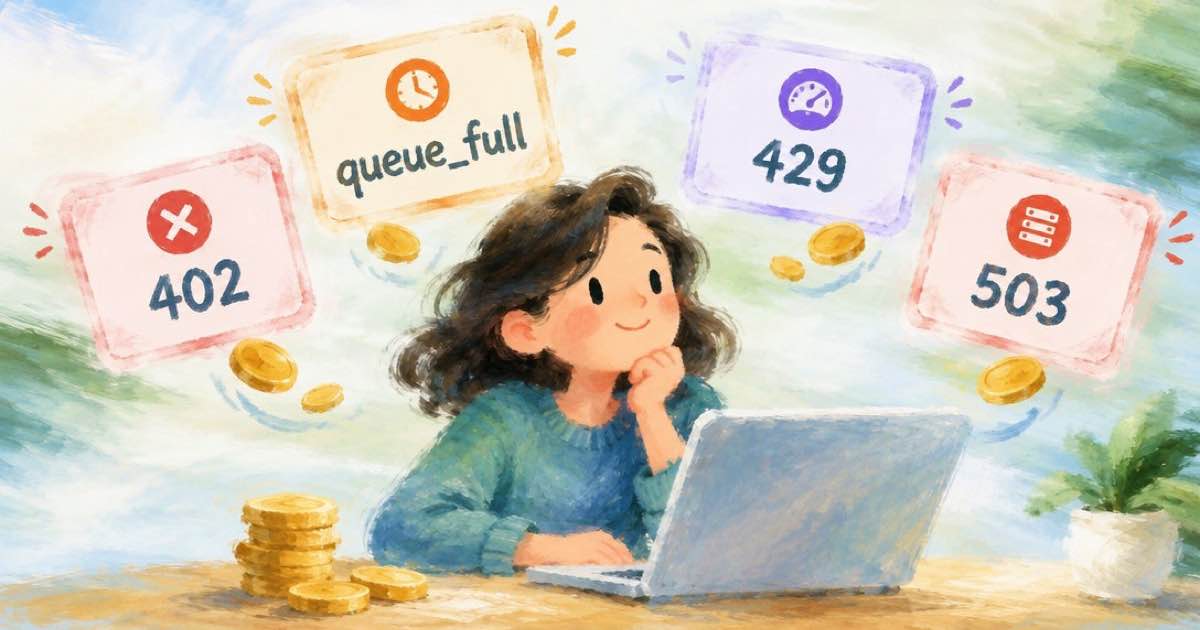
No submit-time rejection on Sume leaves you with a charge. 402 insufficient_credits fails before provider work starts, 429 queue_full releases the reservation of the failed admission, and 429 rate_limited and 503 mean the job was not accepted. What differs is what you should do next: pay, wait, or back off.
The four errors side by side
The table combines the Generation admission and Errors and rate limits pages.
| Error | Why | Money effect | Do this |
|---|---|---|---|
| 402 insufficient_credits | The estimated cost cannot be reserved from the balance | Fails before provider work | Add funds or submit a cheaper request |
| 429 queue_full | Processing and queue capacity are both full | Reservation of the failed admission is released or refunded | Wait for jobs to finish or cancel queued ones, then retry with the same key |
| 429 rate_limited | Request volume over an abuse limit | Job not accepted | Wait for retry-after, back off, keep the key |
| 503 provider_capacity_exceeded | Dispatch queue is full | Job not accepted | Retry later with the same key |
What the docs say you pay for
Paid generation reserves the estimated amount at submit. A successful completion captures it, and failed jobs or failed queue admission release or refund it. The Format errors page adds that a 4xx at create, an idempotent 200 replay and a skipped run cost nothing, but generation that finished before a later failure is not refunded.
Reading the ledger
If a balance looks lower than expected right after a failed submit, check GET /v1/usage. Reserved rows are holds, not spend, and refunded rows show a hold that was given back. Ask support with the request id from the error body; the docs say it is safe to share, unlike API keys or signed URLs.
- Use the same
Idempotency-Keyfor every retry of one logical job. - Do not retry a paid submit blindly after a local timeout.
retry-afteris the first thing to obey on a 429.
A small decision rule
You can reduce the table to one rule. If the error is 402, change the money. If it is queue_full, change the pace. If it is rate_limited or 503, wait and retry. None of these needs a new idempotency key, and none of them needs a refund request.
For a batch of 100 jobs on a Pro workspace, expect queue_full after 24 accepted jobs if you submit them all at once. Submitting in waves, using the live generation_limits headroom, avoids the error entirely. The admission page recommends max(0, concurrency_limit - active - queued) as the budget for new in-flight work.
- Poll with exponential backoff, not tight loops.
- Cancel queued jobs you no longer need; cancellation succeeds only before generation starts.
- After generation starts, cancel returns
409 job_generation_already_started.
Sources
Related posts
More in Pricing
- An 80-cent cap per clip: longest Sume video each model and tier allows
With a hard $0.80 ceiling per clip, which Sume video models can run, and for how long? Wan 3.0 at 480p reaches 12 s; Seedance 2.5 at 1080p cannot start.
- 100-clip batch on a Pro workspace: 24 accepted jobs, 18-job waves
On Pro a workspace holds 4 processing plus 20 queued jobs, so a 100-clip batch needs waves. Wave arithmetic for 100 six-second Wan clips costing $75.00.
- 1080p per-second vs per-clip at 7, 13 and 21 seconds: who accepts each
At 1080p a 7-second clip fits five Sume models, a 13-second clip four, a 21-second clip only Wan 3.0 and Seedance 2.5. Per-second and per-clip prices for each.
- A 1,850-character narration in Sume TTS: price, and what 3 takes add
A 1,850-character script costs $0.0879 in Sume TTS at $0.0475 per 1,000 characters; three takes cost $0.2636. Table by length, and how characters count.
Written by Sume