
Is a 180 second video still a YouTube Short? Trim to 179.5 for margin
YouTube's Shorts page says up to 3 minutes. It says nothing on rounding, so cut to 179.5 s with Sume video trim (duration accepts decimals, $0.02 a job).
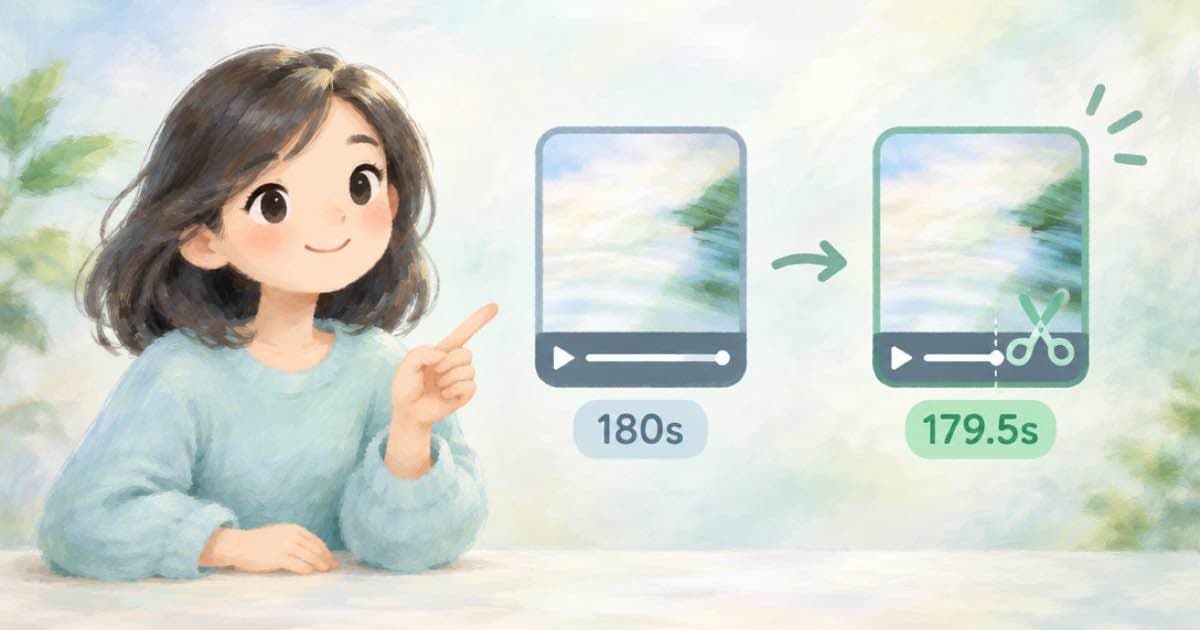
YouTube's Shorts help page (read 2026-10-08) says a Short can be up to 3 minutes long, which makes exactly 180 seconds fit on a plain reading. The page does not say how YouTube measures the length, whether it rounds, or what happens at 180.04 seconds. If you want a margin, cut to 179.5 seconds: Sume video trim takes a decimal duration from 0.2 to 900, so duration 179.5 is a valid request that costs $0.02.
What is and is not stated
Keep the claims small. The page gives one number for length and one for resolution, and nothing about tolerance. The table separates what the page states from what this post is choosing as a safety margin.
| Item | Value | Where it comes from |
|---|---|---|
| Shorts maximum length | Up to 3 minutes | YouTube Shorts help |
| Rounding or tolerance | Not stated | YouTube Shorts help |
| Trim duration field | 0.2 to 900 seconds, decimals allowed | Sume video trim docs |
| Trim price | $0.02 per job | Sume video trim docs |
| Margin used here | 0.5 second under 180 | This post's choice |
Why a margin helps
A video of 180 seconds on the dot can end up a few frames over when audio and video tracks have slightly different lengths. At 30 fps one frame is 0.033 seconds, so 0.5 seconds is 15 frames of room. The exact length of a container is the longer of its tracks, so the audio track can set it. Giving up half a second removes the question and costs you almost nothing in content.
With precision exact (the default), Sume re-encodes frame-accurately, so duration 179.5 yields about 179.5 seconds. With precision keyframe the cut is a stream copy and can start a GOP early, and the docs say to re-base your times against actual_start_seconds, so the length can differ from what you asked.
The request and the check
Send start and duration with an Idempotency-Key. Then read duration_seconds in GET /v1/jobs/:id/result and compare it with 180 before you upload.
curl -X POST https://api.sume.com/v1/video-trim \
  -H "Authorization: Bearer $SUME_API_KEY" \
  -H "Content-Type: application/json" \
  -H "Idempotency-Key: trim-short-margin-001" \
  -d '{
    "video_url": "https://media.sume.com/artifacts/artf_demo/talk.mp4",
    "start": 0,
    "duration": 179.5
  }'
If the clip is already cut
For a finished file, you can read its length with video inspect and frames: false, which returns the probe without stills. Video inspect bills probe compute, so the cost is small but not zero; the docs give no flat price for the probe. If the length is over 180, trim again. A larger cut from a 4 minute source is in this post. For variants at several lengths, see the three-cut post.
Why not 179 or 175
A bigger margin works too, and nothing on the page forbids it. The cost of cutting 5 seconds is five seconds of content, while the cost of 0.5 seconds is almost nothing. Pick the smallest margin that removes your doubt, then confirm with duration_seconds in the result.
If you already have a file that is 180.3 seconds, a trim with start 0 and duration 179.5 removes the last 0.8 seconds. Choose the cut point so it lands on a pause in the speech or a natural end of a shot.
Sources
Related posts
More in Media tools
- Is my clip ready for face swap? Preflight with reference ingest
Face swap wants a 4 to 15 second source with usable audio. Read the clip first with reference ingest purpose face_swap and check duration and audio.silent.
- Join voiceover takes into one gapless wav: timeline audio concat
Timeline audio concat joins up to 20 hosted audio parts sample-exact into one reusable wav for $0.01 per job and returns segment offsets.
- Keyframe or exact trim for a TikTok ad: which keeps 516 kbps?
Sume video-trim exact re-encodes with libx264; keyframe copies the stream. You cannot set bitrate, so measure size / duration against TikTok's 516 kbps floor.
- Korean caption fonts: 29 Hangul faces and each style's default
Sume video captions list 29 Hangul fonts under the font field. See which face each style uses by default and what the API rejects.
Written by Sume