
Six-shot Omni storyboard: a 360p pass costs $1.14, 4K costs $11.28
Draft a six-shot, 5 s-per-shot storyboard on Gemini Omni Flash 1.1: $1.14 at 360p, $3.78 at 720p, $5.64 at 1080p, $11.28 at 4K on Sume.
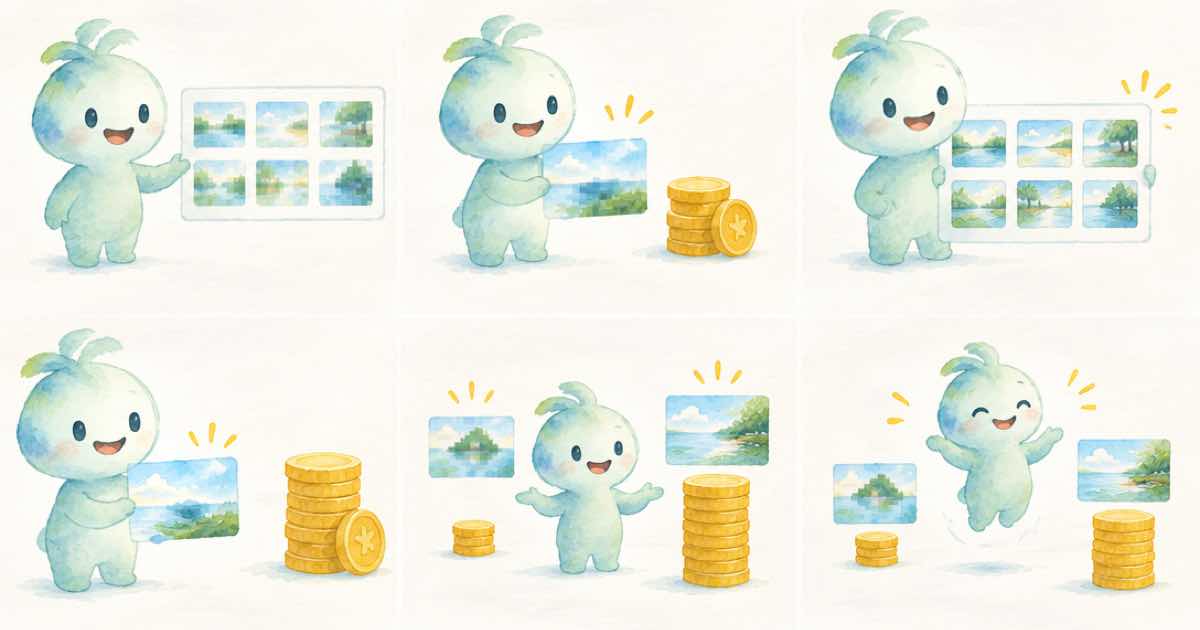
A six-shot storyboard at five seconds a shot costs $1.14 for a full 360p pass on Sume and $5.64 at 1080p. Run the cheap pass first, cut the weak shots, and spend finals only on the survivors.
Google positions the 360p option for "rapid prototyping, storyboard iteration" (Google blog, read 2026-10-05). On Sume it is the resolution: "360p" value of gemini-omni-flash-1.1, with the same 3 to 10 second length range and 16:9 or 9:16 framing.
The price of one storyboard pass
Each shot is a separate job, so six shots means six clips rounded up to the cent. A five-second shot is $0.19 at 360p, which is how six of them reach $1.14 rather than the unrounded $1.125.
| Resolution | One 5 s shot | Six shots |
|---|---|---|
| 360p | $0.19 | $1.14 |
| 720p | $0.63 | $3.78 |
| 1080p | $0.94 | $5.64 |
| 4K | $1.88 | $11.28 |
A workable order of work
- Write six prompts that share one subject line and one style line, then vary only the action and the camera.
- Run all six at 360p in parallel. They are independent jobs, so you do not wait for shot 1 before submitting shot 2.
- Mark each draft keep, reroll or cut. A reroll costs $0.19 at 360p.
- Re-submit only the keepers at 1080p or 4K. Five finals at 1080p are $4.70.
- Join the finals with Timeline, which takes ordered video slots over one audio spine.
Keep the aspect ratio fixed from shot one
Omni takes 16:9 or 9:16 only, so pick before the first draft. If the storyboard drafts at 9:16 and the finals run at 16:9, you have changed the framing, not just the resolution. Set the same aspect_ratio on every request.
For continuity between shots, a reference image works: reference_image_urls accepts up to 10 images and the prompt addresses them as <IMAGE_REF_0>, <IMAGE_REF_1> in list order, per the Video Router page.
{
  "model": "gemini-omni-flash-1.1",
  "prompt": "Shot 3 of 6. <IMAGE_REF_0> walks into the shop, handheld, warm light",
  "reference_image_urls": ["https://example.com/hero-character.png"],
  "resolution": "360p",
  "duration": 5,
  "aspect_ratio": "16:9"
}
Why six shots at five seconds
Five seconds is long enough for one action and short enough that a draft reads at a glance. It sits inside the 3 to 10 second range of the Omni row, so no shot needs trimming. Six shots is a convenient review size: it fits one screen of thumbnails and lands near 30 seconds when joined. Change both numbers freely; the cost scales linearly with seconds, then rounds up per clip.
If your shots differ in length, price each one separately. A 3-second establishing shot is $0.12 at 360p and $0.57 at 1080p, while an 8-second action beat is $0.30 and $1.50.
Handling the shots that fail
Some shots will fail the draft review. The cheap pass makes that boring: a reroll of one shot at 360p is $0.19, so you can try a shot four times for less than a single 1080p take at $0.94. Change one thing per reroll (the camera verb, the lighting phrase, or the action), so you learn which word moved the result.
If a shot keeps failing, the usual cause is that the prompt asks for two things in five seconds. Split it into two shots and the storyboard becomes seven. At 360p that is another $0.19, and at 1080p another $0.94.
From storyboard to cut
Once finals are back, assemble them with the Timeline API, which takes one audio spine plus ordered video slots and returns one MP4. Its inputs must already be media in your workspace, so import the finished clips first. Because Omni always renders native audio, each shot arrives with its own sound; decide before assembly whether you keep those tracks or lay one spine under the cut. A 30-second film from six 5-second shots at 1080p is $5.64 of video before any assembly cost.
Keep every job id. When a client asks for one shot to change, you re-run that one shot, not the six.
What it buys you
The point of the table is the ratio. The full storyboard in 360p is about a tenth of the same storyboard in 4K, and you only learn which shots work by seeing them. Spend the savings on more variants of the shots that matter.
Sources
Related posts
More in Use cases
- 60-minute podcast to 3 captioned clips: $1.52 on Sume
A one-hour episode, split into audio, transcribed at $0.01 a minute, cut to 3 clips and captioned costs about $1.52. OpusClip plans are $15 to $29.
- Slide deck to video: ten slides as Wan 3.0 reference images on Sume
Turn a slide deck into a 30 second Wan 3.0 clip on Sume by exporting up to ten slides as images. Limits, a request body, and the $3.75 cost at 720p.
- Slow, clear learner audio: Sume TTS speed 0.6 and sentence slices
Sume TTS speed goes down to 0.6. For learner audio, render at 0.8, slice by sentence with word timings, and keep the full pass for comparison. Cost per lesson.
- Sneaker drop teaser: test on Seedance 2.0 Mini, finish on 2.5
Plan a 10-second sneaker teaser: five 480p tests on Seedance 2.0 Mini, one 720p keeper on 2.5, with exact Sume prices for each step and the reason to split.
Written by Sume