
Re-queue only failed items of a Sume Format bulk queue
A completed bulk queue is not all succeeded. Read counts.failed, pick the failed indexes, and resend them under a new Idempotency-Key. Python, offline.
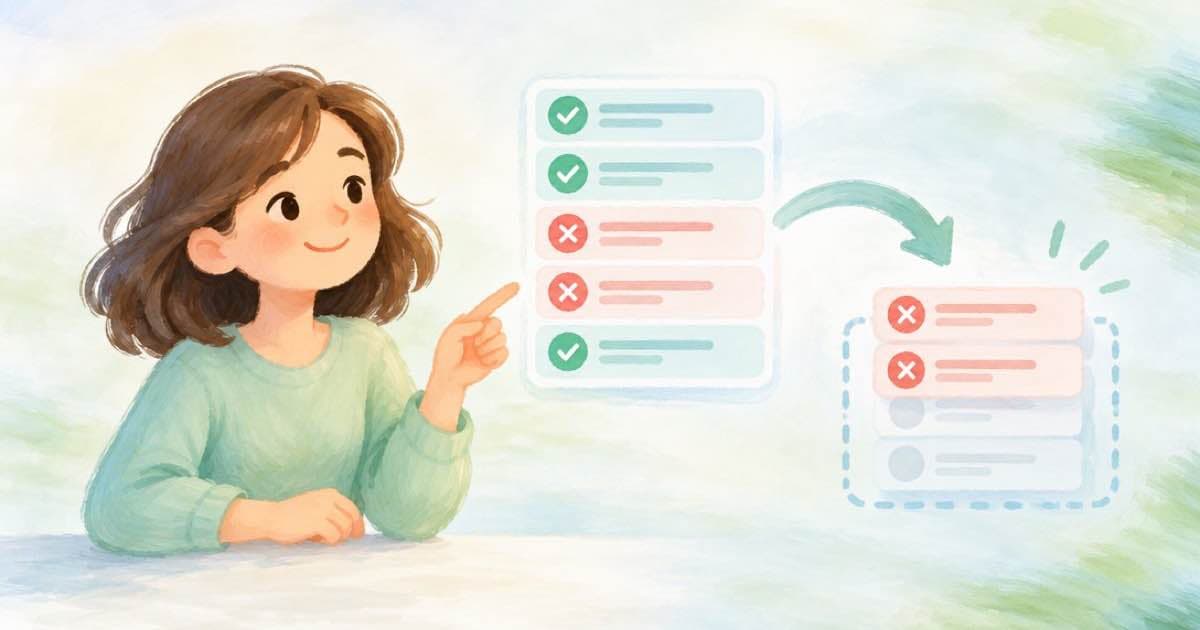
When a Sume Format bulk queue finishes with failed items, build a new queue from only those items and send it under a new Idempotency-Key. Do not reuse the old key: a replay of a spent key returns 202 with the old queue and starts nothing, and a changed payload under the same key returns 409 idempotency_conflict. The Python helper below reads the queue receipt, picks the failed indexes, and builds the retry body.
A queue with status completed means that every item is terminal, not that every item succeeded. Branch on counts.failed and counts.canceled before you tell anyone the batch is done.
What the receipt gives you
A failed item that never started a run keeps its index with run_id: null and an error such as format_run_failed_to_start. To learn why a started child failed, read its run receipt at GET /v1/format-runs/{run_id}, not only the queue item.
| Field | Notes |
|---|---|
| data.status | queued, running, or completed. Completed means all items are terminal. |
| data.counts | total, queued, running, completed, failed, canceled |
| data.items[].index | Zero-based position in the items you submitted |
| data.items[].status | queued, running, completed, failed, or canceled |
| data.items[].run_id | Null if the item failed before a child run started |
| data.items[].error | code and message, or null |
The helper
The example queue has five items. Index 1 failed before it started, index 3 failed after it started, and index 4 was canceled. The helper selects only failed, so it returns indexes 1 and 3. Decide separately whether canceled items should be retried, because a cancel is usually deliberate.
import json, uuid

def retry_batch(original_items, queue, concurrency=3):
    failed = [row["index"] for row in queue["data"]["items"] if row["status"] == "failed"]
    body = {"concurrency": concurrency, "items": [original_items[i] for i in failed]}
    return failed, str(uuid.uuid4()), body

items = [{"instruction": f"clip {n}"} for n in range(1, 6)]
queue = {"data": {"status": "completed", "counts": {"total": 5, "failed": 2}, "items": [
    {"index": 0, "status": "completed", "run_id": "arun_a", "error": None},
    {"index": 1, "status": "failed", "run_id": None, "error": {"code": "format_run_failed_to_start"}},
    {"index": 2, "status": "completed", "run_id": "arun_c", "error": None},
    {"index": 3, "status": "failed", "run_id": "arun_d", "error": {"code": "format_run_failed"}},
    {"index": 4, "status": "canceled", "run_id": "arun_e", "error": {"code": "format_run_canceled"}}]}}
failed, key, body = retry_batch(items, queue)
print(failed, len(key), json.dumps(body))
Sending the new queue
Post the body to POST /v1/formats/{handle}/{slug}/bulk-runs with the key from the helper in the Idempotency-Key header. The create accepts a concurrency between 1 and 16 and between 1 and 100 items. Every item must name at least one of instruction, input, previous_run_id, or attachments; a bad item fails the whole create with 400 invalid_request and details.index, before any queue exists.
Keep a map from the new queue's item positions back to your original indexes, because the new queue starts counting from zero. In the example, new item 0 is old item 1 and new item 1 is old item 3.
Cost control
Each item can carry its own generation_spend_cap_usd, and the queue has no queue-level cap. Worst-case spend for a retry is the sum of the caps of the items you resend. Check that sum before you post, and check the balance, since a child that cannot be admitted becomes a failed item after the create has already returned 202.
Deciding what counts as failed
Not every failure deserves a retry. An item that failed with a validation problem in your input will fail again with the same input, so fix the input first. An item that failed to start because of a balance or capacity problem is a good candidate once the cause is gone.
Log each retry as its own queue and keep the link to the first queue id. When a second queue also has failures, you can then see how many rounds an item has been through, and you can stop after two. Retrying forever turns a data problem into a spend problem.
Sources
Related posts
More in Formats
- Same ad Format, new model: log three receipt fields on every run
To keep an ad format steady when the model changes, pin the Format, treat model as the orchestrator only, and log version, model and schema.
- Shortest ad video: Pinterest 4 s, LinkedIn 3 s, Google action 10 s
Minimum video length per ad platform, read from each vendor page on 2026-10-08, against the 0.2 second floor of Sume video trim. One cut, one duration check.
- Stop a Sume Format bulk run mid-batch: cancel starts the next item
The bulk API has no cancel-queue endpoint, and canceling a running child frees its slot for the next item. How to stop a runaway batch, and how to size queues.
- Sume's 27 catalog Formats: slugs, 404 rule and the io profile
Sume lists 27 catalog Formats at the sume handle. An unlisted slug gives 404. Read description and io before you run one, then fork it to change it.
Written by Sume