
ElevenLabs TTS seed and free regenerations vs Sume TTS retry cost
ElevenLabs offers a seed and up to two free regenerations of identical requests. On Sume a retry with the same Idempotency-Key returns the same job. Compare.
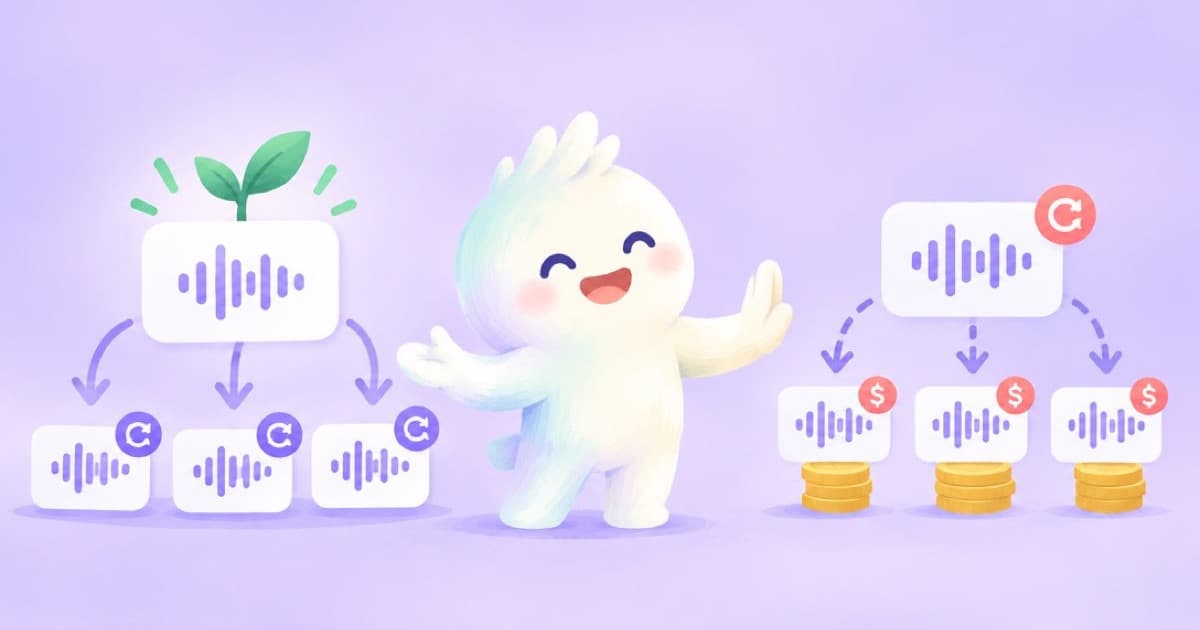
Two different meanings of retry
People say retry to mean two things: send the same request again because the first one did not come back, and ask again hoping for a different take. They are billed differently, and the two vendors treat them differently.
ElevenLabs' text to speech page lists a seed parameter for determinism, and says you get up to two free regenerations when the content and settings are identical. That covers the second meaning: you can re-roll a take within a limit.
What Sume does
Sume covers the first meaning with the Idempotency-Key header. Submit with a key; if your connection drops or the wait window ends, send the same request with the same key and you get the original job back, not a second paid generation. Reusing a key with a different payload returns 409 idempotency_conflict.
The Jobs and results page also says a wait that runs out must not trigger a new paid submit. Poll the job instead.
| Situation | ElevenLabs | Sume TTS 1.0 |
|---|---|---|
| Same request, lost response | Handled by your own retry logic | Same Idempotency-Key returns the original job |
| Want a different take | Up to 2 free regenerations when content and settings are identical | A new request with a new key is a new paid job |
| Reproducibility | seed parameter | No seed field is documented in the API reference |
Practical consequence for budgets
If your workflow depends on picking the best of several takes, the number of takes is a cost multiplier on Sume: each new request is billed at $0.0475 per 1,000 characters. Four takes of a 1,000-character line is $0.19.
Control that by auditioning short lines. Render the first sentence or two in several voices or emotion settings, choose, and only then submit the whole script.
A safe retry pattern
- Create one UUID per intended generation and reuse it on every network retry of that generation.
- When a sync wait returns without audio, poll
/v1/jobs/:id/statusinstead of resubmitting. - When you want a new take on purpose, mint a new key and treat it as a new charge.
- Log the key next to the job id so support questions are answerable.
Budgeting a voice-selection round
Suppose you audition one 400-character line in five voices. That is 2,000 characters, or $0.095. Picking by listening to short lines is cheap; picking by rendering five full 15,000-character scripts is $3.56 of mostly discarded audio.
The free regeneration allowance on the vendor page is specific to identical content and settings, so it helps when you want another take of the same thing, not when you change the voice.
Takeaway
ElevenLabs has a deterministic seed and a small free re-roll allowance. Sume has no seed to document, but a network retry never double-bills when you keep the same Idempotency-Key. Pick your re-rolls deliberately and audition short lines first.
Sources
Related posts
More in Comparisons
- ElevenLabs v4 Turbo vs Flash vs v3: price per 1,000 characters
ElevenLabs API list per 1K characters: v4 Turbo $0.011 until Oct 12 (then $0.04), Flash/Turbo $0.04, v3 Multilingual $0.08, v4 $0.022 (then $0.08).
- Face and body swap video AI: Recast vs Sume's avatar face swap
Sume has two ways to put someone else in a video: H3 Max Recast swaps the person from a photo, Beta Face Swap applies a ready avatar's face. Which to use.
- Face swap vs H3 Max Recast: which swaps the person in a video?
Sume offers two ways to put a different person in a video: Avatar Face Swap (Beta) and H3 Max Recast. Inputs, length limits, audio and price side by side.
- fal list vs Sume price for Seedance 2.5: what 100 clips cost extra
For 100 five-second 720p Seedance 2.5 clips, fal list is about $231 and Sume is about $289: $57.78 more, the 25 percent house margin. What it covers.
Written by Sume