
ElevenLabs TTS on fal at $0.10 per 1,000 characters vs direct and Sume
fal lists ElevenLabs TTS at $0.10 per 1,000 characters, ElevenLabs lists $0.08 for v3, Sume is $0.0475. A 2,000-character script: $0.20, $0.16, $0.095.
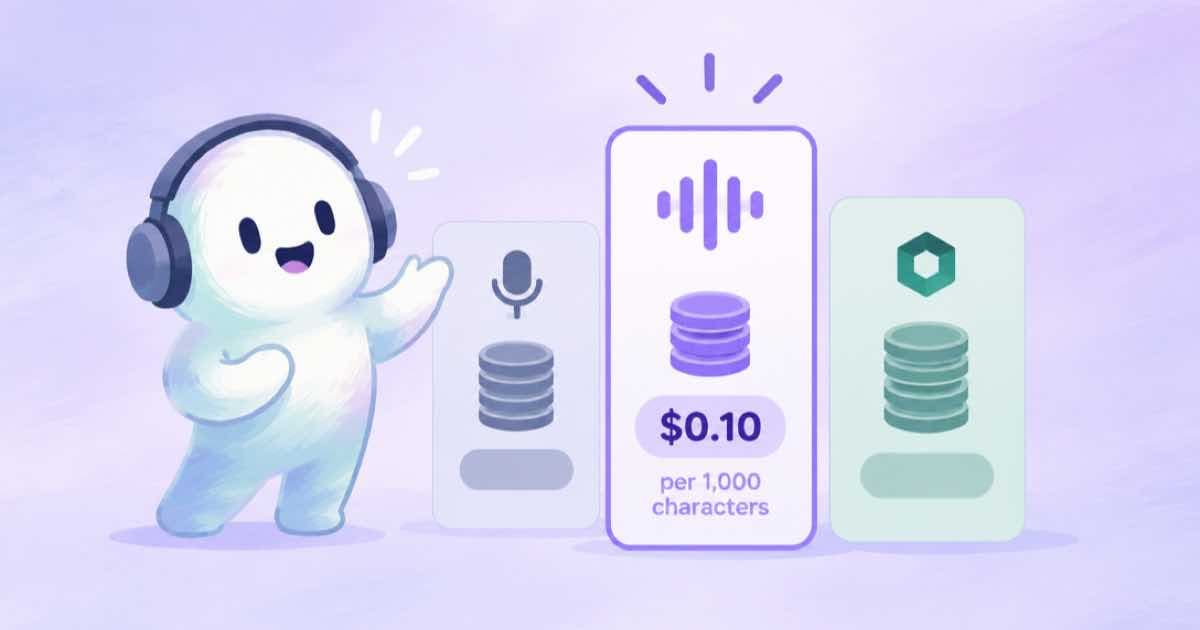
fal's pricing page shows ElevenLabs text to speech at $0.10 per 1,000 characters. ElevenLabs' own API pricing page lists v3 and v2 Multilingual at $0.08 per 1,000 characters and Flash/Turbo at $0.04. Sume's TTS is $0.0475 per 1,000 characters. For a 2,000-character script that is $0.20 on fal's listed example, $0.16 on ElevenLabs v3, and $0.095 on Sume. Sources: fal pricing and ElevenLabs API pricing, both read 2026-10-04.
These are different engines, so the comparison is about unit price and unit shape, not voice quality. Listen to each before you pick one.
The four price lines
fal's page lists audio examples with units: ElevenLabs TTS at $0.1 per 1000 characters. It does not say which ElevenLabs model that line is, so I treat it as an example line, not a catalog guarantee. ElevenLabs' page lists v4 at $0.022 under a discount until Oct 12 (regular $0.08), v4 Turbo at $0.011 under the same discount (regular $0.04), v3 and v2 Multilingual at $0.08, and Flash/Turbo at $0.04.
Sume's TTS 1.0 is priced per transcript character after the 1.25 house multiplier, with spaces and punctuation counted, and a maximum of 20,000 characters per job. The rate is $0.0475 per 1,000 characters, and GET /v1/catalog shows the live figure (models overview).
| Source | Line | Per 1,000 chars | 2,000 chars | 60,000 chars |
|---|---|---|---|---|
| fal | ElevenLabs TTS example | $0.10 | $0.20 | $6.00 |
| ElevenLabs | v3 / v2 Multilingual | $0.08 | $0.16 | $4.80 |
| ElevenLabs | Flash/Turbo | $0.04 | $0.08 | $2.40 |
| Sume | TTS 1.0 | $0.0475 | $0.095 | $2.85 |
A batch of 100 scripts
Take 100 voice-overs of 600 characters each, which is 60,000 characters. The last column of the table is that total: $6.00 on fal's example line, $4.80 on ElevenLabs v3, $2.40 on Flash/Turbo, $2.85 on Sume. Flash/Turbo is the cheapest line on the list, and Sume sits between it and v3.
Shorter jobs change the picture only if a minimum applies. None of the three pages I read lists a per-request minimum for TTS, but I did not read terms beyond the pricing pages.
What differs besides price
- Billing unit: all three bill characters for TTS, so a script that is padded with stage directions costs more on every one.
- Wallet: Sume bills one USD balance across image, video, audio and avatar jobs, which matters if the voice-over is one line in a larger job.
- Voices and models: ElevenLabs lists its own voice library. Sume lists its own voices and a TTS router catalog; check
GET /v1/tts-router/modelsfor the engines you can pin. - Promotions: ElevenLabs' v4 discount ends Oct 12, so a v4 estimate made today will not hold after that date.
A fair way to test
Pick one 600-character script, render it on each service, and have two people listen blind. Record the price per 1,000 characters for each, not the plan price, so your cost estimate survives a plan change. A short test costs under 10 cents on any of the options above.
Sources
Related posts
More in Comparisons
- fal image model list vs the Sume catalog: how to check by query
fal.ai lists Seedream 5.0, GPT Image 2.5, Flux 2, Nano Banana 2, Ideogram 4 and Krea 2. How to see which ones a Sume key can call, with a short Python script.
- fal retry budgets and 1-hour grace vs Sume job error categories
fal's changelog lists per-condition retry budgets and termination grace of up to one hour. Sume job errors carry a category, a next action and retry-after.
- fal's Usage API vs Sume's per-job, per-run cost reads
fal's changelog lists a Usage API for cost attribution. Sume's GET /v1/usage filters by job_id, run_id or thread_id and returns a summary. How to attribute.
- Firefly's Kling Omni references vs Sume input_references
Adobe Firefly added reference images for Kling 3.0 Omni in September 2026. On Sume, references are input_references on /v1/videos, checked per model.
Written by Sume