
45-second voice-over: four H3 Max segments, $4.80, or one Fabric job
A 45-second line must be four H3 Max lip-sync segments (about $4.80 at 768p) or one Fabric 1.0 job (about $8.44 at 720p). What each route allows and costs.
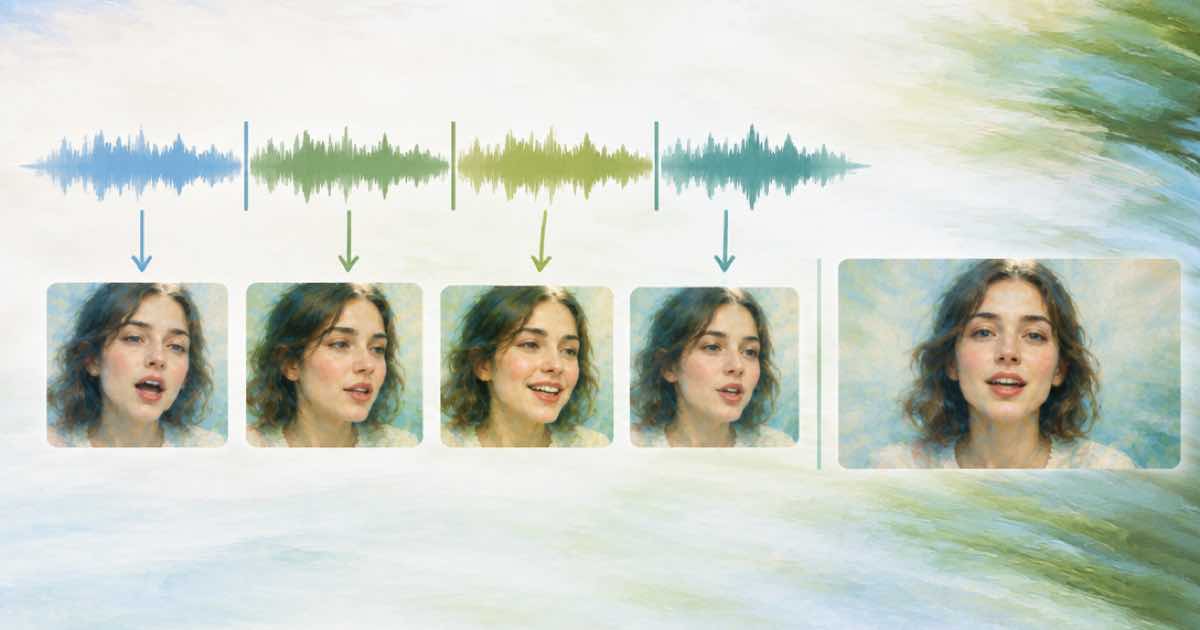
A 45-second voice-over cannot go through the H3 Max lip-sync route in one piece, because that route accepts 5 to 14.8 seconds. Split it into four segments of about 11.25 seconds and the lip-sync cost is about $4.80 at 768p; send the whole file to Fabric 1.0 instead and the cost, from the docs rate, is about $8.44 at 720p. The cheaper path asks for more work, and the face is made by two different models.
The numbers
H3 Max bills ceil(duration_seconds) at $0.10 per second at 768p. Four segments of 11.25 seconds each bill 12 seconds, so 48 billed seconds. Fabric 1.0 at 720p is the provider's $0.15 per second times 1.25, or $0.1875 per second; the docs show 5 seconds at 720p reserving $0.94. For 45 seconds that is $8.4375, which I round to $8.44 and which assumes whole-second billing.
| Route | Shape | Billed seconds | Cost |
|---|---|---|---|
| H3 Max lip sync, 768p | 4 x 11.25 s | 48 | $4.80 |
| H3 Max lip sync, 480p | 4 x 11.25 s | 48 | $3.00 |
| H3 Max lip sync, 1080p | 4 x 11.25 s | 48 | $9.60 |
| Fabric 1.0, 720p | 1 x 45 s | 45 | about $8.44 |
Steps for the segmented route
- Split the script at sentence ends so each part reads in 5 to 14.8 seconds.
- Generate TTS for each part separately. Do not cut one long audio file afterwards.
- Submit four lip-sync jobs with the same still or avatar handle and resolution.
- Join the four videos with
POST /v1/timeline-1.0/render; 45 seconds bills one minute, $0.10. - Set the output frame rate on purpose if you also mix other clips.
Which one to pick
Pick segments if you want the lower price and the control to redo one part without paying for all four. Pick Fabric if you want a single continuous take with no joins, accept the higher price, and your audio is under 10 MB and Sume-hosted. Fabric accepts up to 300 seconds, so 45 seconds is well inside it.
The Sume guidance is to use one lip-sync model per run. Mixing H3 Max for the middle and Fabric for a short tail makes the face look slightly different between cuts, so plan the lengths so that every part fits one model.
Reading the cost per finished second
Divide by the 45 seconds of finished video: the segmented H3 Max route is about 10.7 cents per finished second at 768p, and the Fabric route is about 18.8 cents. Add the timeline join, $0.10 for the minute, and the segmented figure becomes $4.90, or about 10.9 cents per second. The difference is large enough to matter once you make dozens of these, and small enough that a single 45-second video can reasonably choose the simpler single-job path.
What Sume does not do
Sume does not split your audio and does not stitch the lip-sync clips on its own. It also cannot change the fact that the H3 Max route refuses 15 seconds rather than trimming it. The Fabric price above is derived from the docs rate and multiplier; confirm it in the admission preview before a large batch.
Sources
Related posts
More in Media tools
- 90 s Audio Library song in a 3-minute Short: what covers the rest
YouTube lets a Shorts Audio Library song play up to 90 s in a 3-minute Short. Sume Music 1.0 is $0.125 a track; Timeline loops a bed for $0.30.
- A 1.5-second clip allows a 0.75-second fade: Timeline limits
Timeline 1.0 caps a transition at 1 second and 50% of the shorter neighbor clip. Table of the maximum fade for 0.5 to 4 second clips, plus the refusal codes.
- Amazon Sponsored Brands video: cut a 20-second window with Sume trim
Amazon lists 6 to 45 seconds for Sponsored Brands video and prefers 20 or less. Use Sume video trim to cut an exact range from a longer clip for $0.02 a job.
- Amazon video ad frame rate: set Sume Timeline fps to 24, 25 or 30
Amazon lists 24, 25 and 30 fps among its rates. Sume Timeline takes 24, 25, 30 or 60. Choose a rate that matches the source to avoid the resample warning.
Written by Sume